
Only 28% of Workers Say It's a Good Time to Find a Job — What That Means for Your Money
You probably still have your job. But you're stuck in it — and that's costing you more than you think.
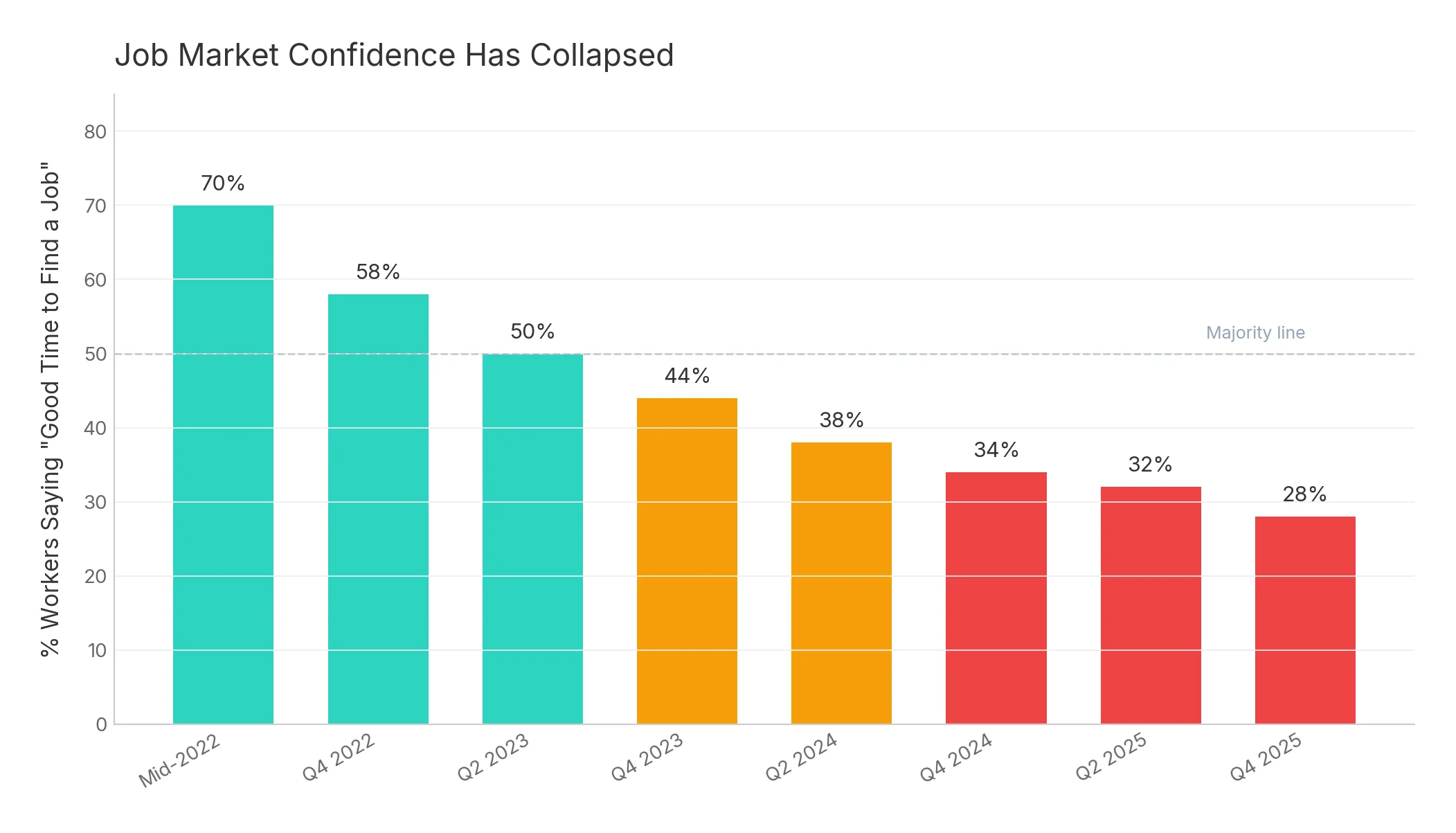
New data from Gallup shows worker confidence has collapsed to a record low. Only 28% of American workers say now is a good time to find a quality job, down from 70% just four years ago. This isn't a layoff story. It's a "you can't leave" story — and it has a real price tag.
TL;DR
- Gallup Q4 2025: Only 28% of workers say it's a good time to find a quality job — down from 70% in mid-2022, a 42-point collapse
- The job market is frozen, not broken: Unemployment is 4.4%, but nobody's hiring either — the quit rate has been below 2.0% for 7 straight months
- The job-switch pay premium collapsed 77%: From an 8.4 percentage point gap in 2022 to just 1.9 points today (ADP data)
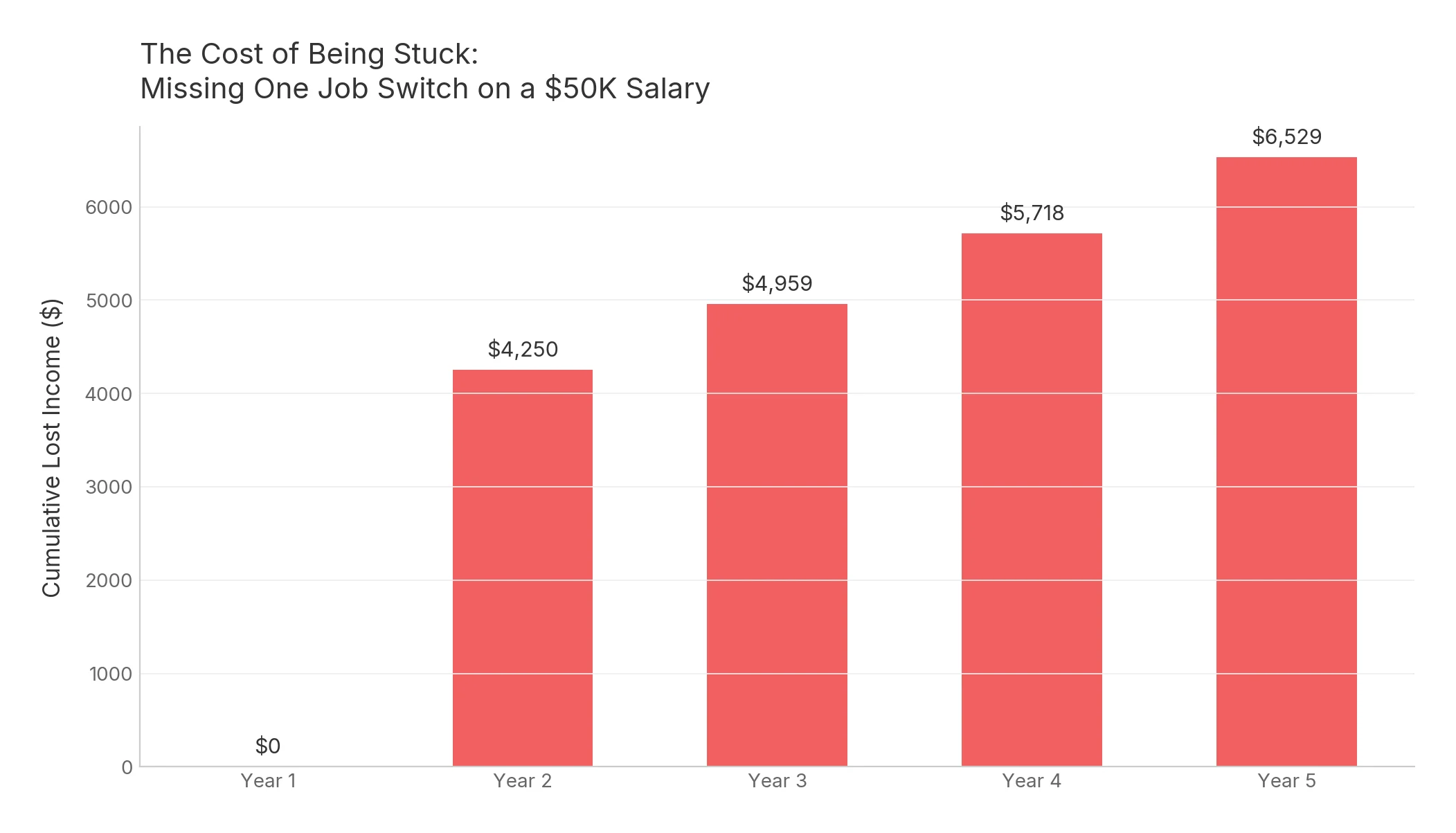
- The hidden cost: On a $50K salary, missing one job switch costs you $4,250 in Year 1 and $21,455 over five years
- What to do: Know your market rate, build an emergency buffer, negotiate from where you are, and prepare for the thaw
Table of Contents
- The Numbers: A 42-Point Confidence Collapse
- Frozen, Not Broken — Why This Matters
- The Hidden Cost of Being Stuck
- Who's Getting Hit Hardest
- What You Can Actually Do About It
- Frequently Asked Questions
The Numbers: A 42-Point Confidence Collapse
In mid-2022, during the tail end of the Great Resignation, 70% of American workers said it was a good time to find a quality job. Companies were desperate to hire. Workers had options. Quitting paid off — literally.
Fast forward to late 2025, and that number has cratered to 28%, according to Gallup's Q4 2025 workforce survey. That's a 42-point drop — the largest collapse in job market confidence Gallup has recorded.
It gets worse. For the first time in Gallup's tracking history, more workers are now struggling in their lives (49%) than thriving (46%). Employee engagement has fallen to 31% — the lowest in a decade. More than half of workers are actively looking for a new job or watching for opportunities. And nearly half of those searching say it's been a negative experience.
Gallup's own description of the American workforce right now: "restless but largely stuck."
Frozen, Not Broken — Why This Matters
Here's the counterintuitive part: unemployment is only 4.4% as of February 2026, per the BLS. That's not great, but it's not a crisis either. Most people still have jobs.
The problem isn't mass layoffs — it's mass paralysis. The economy hit a triple uncertainty lock:
- Tariffs added an average of $1,500 per household in 2026, according to the Tax Foundation
- The Iran conflict is injecting geopolitical risk that's freezing hiring decisions — CNN reported that "uncertainty is delaying, not canceling, hiring plans"
- Interest rates are stuck at 3.50–3.75% after the Fed held steady in March, with only one cut projected for 2026
The result? February saw the economy lose 92,000 jobs — the first negative payroll print — while the JOLTS quit rate stayed below 2.0% for seven consecutive months. People aren't getting fired. They're also not quitting.
SHRM calls it a "low-hire, low-fire" labor market. Business Insider calls it the "Great Freeze." Stanford economist Nicholas Bloom's advice to workers in 2026: "Don't leave."
The Hidden Cost of Being Stuck
Here's what nobody talks about: being stuck has a price tag.
During the Great Resignation, switching jobs was the fastest way to get a raise. According to ADP data, workers who switched jobs in April 2022 earned 8.4 percentage points more than those who stayed. That gap — the "job-hop premium" — has collapsed to just 1.9 percentage points as of January 2026, per Axios. The Atlanta Fed's wage tracker shows an even smaller gap: 4.0% for switchers vs. 3.5% for stayers.
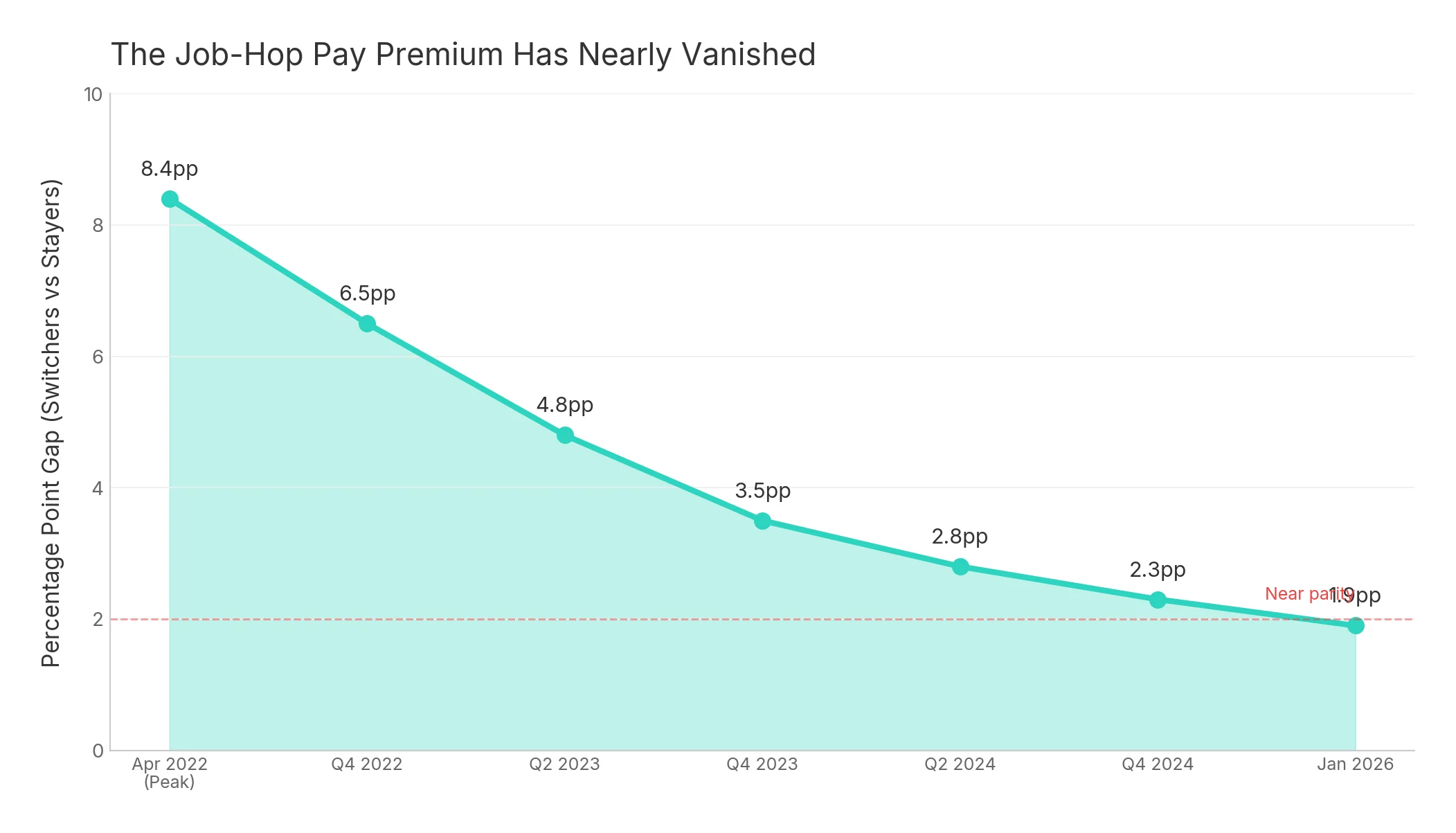
CNBC reported that pay increases for job switchers are now "roughly a third of what they were at the peak." A Bank of America Institute analysis found the median pay bump from switching was just 4% in January 2026 — down from roughly 12% in 2022.
But the bigger cost is the switch you never got to make.
Let's run the math on a $50,000 salary (close to the U.S. median):
| Scenario | Year 1 Salary | Year 5 Salary |
|---|---|---|
| Switched jobs (12% bump in Year 1, then 4.5% annual raises) | $56,000 | $63,905 |
| Stayed put (3.5% annual raises) | $51,750 | $57,376 |
| The gap | $4,250 | $6,529 |
Over five years, that one missed job switch costs you $21,455 in total unrealized income. And that's on a $50K salary. Scale it up for a $75K or $100K earner, and the numbers get painful fast.
Now add the $1,500/year in tariff costs that hit every household. The combined "invisible tax" of a frozen market is roughly $5,750 per year — money that doesn't show up on any bill but disappears from your financial trajectory all the same. And that's before the weekly costs that have no salary-switch escape hatch at all: a 30% jump in gas prices increase weekly cost of $47/week for the average household on top of the tariff hit.
Who's Getting Hit Hardest
The frozen market isn't hurting everyone equally.
College-educated workers are the most pessimistic for the first time in Gallup's trend data. Only 19% say it's a good time to find a quality job — a reversal from prior years, when they were more optimistic than workers without degrees. White-collar hiring slowdowns in tech and professional services are the likely driver.
Younger workers are more negative than older ones about job quality, and they're more likely to be actively searching — with less success.
Federal employees have seen the steepest decline in wellbeing. Their "thriving" rate dropped 12 percentage points since 2022 (from 60% to 48%), far outpacing the six-point drop for workers overall.
And for anyone earning under $60K, the math is ruthless: the $1,500/year tariff hit takes a bigger bite out of a smaller paycheck, while the frozen market eliminates the one mechanism — job switching — that historically closed income gaps fastest. If you hit a cash shortfall in a frozen market, the old escape hatch (switching for a raise) isn't there — so our borrow money until payday guide becomes the more realistic playbook for bridging a week without creating next week's problem.
What You Can Actually Do About It
A frozen market feels helpless, but it isn't. Here are five moves that work even when you can't switch jobs:
1. Know Your Market Rate — Even If You're Not Leaving
Use Glassdoor, Levels.fyi, the BLS Occupational Outlook Handbook, or ask peers in your field directly. Information is leverage. Even if you can't credibly threaten to leave, knowing your market rate gives you ammunition for performance reviews and compensation conversations.
2. Build a Cash Buffer
This is the worst possible time to have zero financial cushion. An unexpected expense — a car repair, a medical bill, a rent increase — hits harder when you can't earn your way out of it through a job switch. Even $500 in a separate account covers the most common emergencies that send people into debt.
The easiest buffer source in 2026: your tax refund. Our tax refund plan turns the average $3,623 refund into $5,233+ of first-year financial value — with the first $500 going exactly where it needs to go in a frozen market, which is a separate account earmarked for the emergency you can't job-switch your way out of.
3. Stack Skills, Not Applications
The average job search now takes five months according to Zippia. Spray-and-pray applications don't work in a market where employers have dozens of candidates per opening. Instead, invest in one skill that makes you harder to replace and more valuable when the market thaws — certifications, a portfolio project, or a cross-functional skill your current role doesn't require but your next one will.
4. Negotiate From Where You Are
Your employer knows it's cheaper to retain you than to hire your replacement. Retention budgets still exist even when hiring budgets are frozen. Ask for what you want: a raise, remote flexibility, a title change, a better schedule. Frame it around your value delivered, not market conditions. The worst they can say is no.
5. Prepare for the Thaw
Markets unfreeze. When this one does, workers who've been building skills and tracking their market rate will move fastest. Keep your resume updated. Stay visible on LinkedIn. Maintain relationships with recruiters. The people who come out of a freeze ahead are the ones who were ready when it ended.
Frequently Asked Questions
Why do only 28% of workers say it's a good time to find a job?
Gallup's Q4 2025 survey captured worker confidence collapsing due to a frozen job market. Tariff uncertainty, the Iran conflict, elevated interest rates at 3.5–3.75%, and widespread hiring freezes across technology and manufacturing sectors have made employers reluctant to add headcount — even though mass layoffs haven't materialized.
What is a frozen job market?
A frozen job market means employers aren't doing mass layoffs, but they've also stopped hiring at meaningful scale. The JOLTS quit rate has stayed below 2.0% for seven consecutive months, meaning workers feel stuck in their current positions and aren't voluntarily leaving.
How much does a frozen job market actually cost you?
On a $50,000 salary, missing one job switch can cost $4,250 in the first year alone. Over five years, the compounding gap reaches $21,455 in unrealized income. Add $1,500/year in tariff costs, and the "invisible tax" of being stuck totals roughly $5,750 per year.
Is the job market going to get better in 2026?
The outlook is mixed. February 2026 saw 92,000 job losses, consumer confidence remains near pandemic lows, and the Iran conflict is adding fresh uncertainty. The Fed projects unemployment will average 4.4% through Q4 2026 and only forecasts one rate cut this year. EY-Parthenon's chief economist says uncertainty is "delaying, not canceling" hiring — which suggests a slow thaw rather than a sudden recovery.
What should you do if you feel stuck in your job?
Focus on what you can control: know your market rate for negotiating power, build a cash buffer against unexpected expenses, invest in a high-value skill, negotiate within your current role, and stay ready for when the market unfreezes. The average job search takes five months in 2026 — preparation matters more than volume.
The Bottom Line
The story of 2026's job market isn't mass layoffs. It's mass paralysis. Most people still have jobs. What they've lost is options — and options have a dollar value.
That 42-point confidence collapse from Gallup isn't just a sentiment number. It translates into real money: missed raises, missed switches, and missed leverage in every negotiation. When you add tariff costs on top, the average household is paying thousands per year for a problem that doesn't even show up on a bill.
You can't control the Fed, the tariffs, or the Iran conflict. But you can control your market knowledge, your cash buffer, and your readiness. The freeze will end. Be ready to move when it does.
Related Articles

Your Grocery Bill Just Got $540 Heavier — Here's Exactly What Tariffs Are Costing You
Tariffs are adding $540/year to the average family's grocery bill. See which foods cost the most, who gets hit hardest, and 6 ways to fight back.

Gas Prices Just Jumped 30% — Here's What That Actually Costs You Per Week (and What to Do About It)
Gas prices rose $1.03/gallon in one month. See the real weekly cost by household type and 4 strategies to save up to $1,334/year.