
Your Grocery Bill Just Got $540 Heavier — Here's Exactly What Tariffs Are Costing You
Your grocery receipt looks different lately. Not dramatically — a few dollars here, a few dollars there. But those small bumps add up. And they're about to get worse.
Tariffs on imported goods are quietly pushing grocery prices higher across the board. For the average family, that's an extra $540 per year — and we're only halfway through the price increase. Here's exactly what's happening, who pays the most, and what you can actually do about it.
TL;DR
- Tariffs are adding roughly $45/month ($540/year) to a family's grocery bill — on top of normal inflation
- Businesses absorbed 80% of tariff costs in 2025. By late 2026, consumers will absorb 80%. The worst is ahead.
- Beef is up 10.1%, coffee up 33%, fresh vegetables up 4.8% — the USDA projects most food categories will rise in 2026
- Low-income households get hit 3.6x harder relative to income than the wealthiest 1%
- 6 concrete steps you can take right now to fight back
Table of Contents
- The $540 Number: Where It Comes From
- The Pass-Through Flip: Why Prices Are Rising Now
- Which Foods Are Getting Hit Hardest
- The Coffee Example: What 50% Tariffs Look Like in Your Cup
- Who Pays the Most (It's Not Who You Think)
- Will Prices Come Back Down?
- 6 Things You Can Actually Do About It
- Frequently Asked Questions
The $540 Number: Where It Comes From
The Yale Budget Lab estimates the current tariff regime costs the average household $780 to $1,338 per year across all goods. Groceries are a big chunk of that.
For a family spending around $800 a month on food — close to the average for a household of three or four — tariff pass-through adds about $45 per month. That's $540 per year, and it's not replacing normal inflation. It's on top of it.
The USDA already forecasts food-at-home prices rising 3.1% in 2026. Tariffs push that number higher.
To put $540 in perspective: that's roughly the cost of 2 months of car insurance, or 10 weeks of gas, or your entire annual streaming budget. Gone — at the grocery store.
And it's not happening in isolation. Our analysis of the 30% jump in gas prices increase weekly cost found households are already paying $47/week more at the pump. Stack groceries on gas and the average family is absorbing $3,000+ a year in new costs without a single raise to cover them.
The Pass-Through Flip: Why Prices Are Rising Now
Here's what most people don't realize: tariffs didn't hit your grocery bill all at once. There's a delay.
In 2025, businesses absorbed about 80% of tariff costs themselves. Retailers ate the margins. Importers swallowed the difference. That's why you might not have felt the full impact yet.
But that's changing. JPMorgan projects that by late 2026, the ratio will flip — businesses will absorb only 20%, passing 80% of tariff costs to consumers.
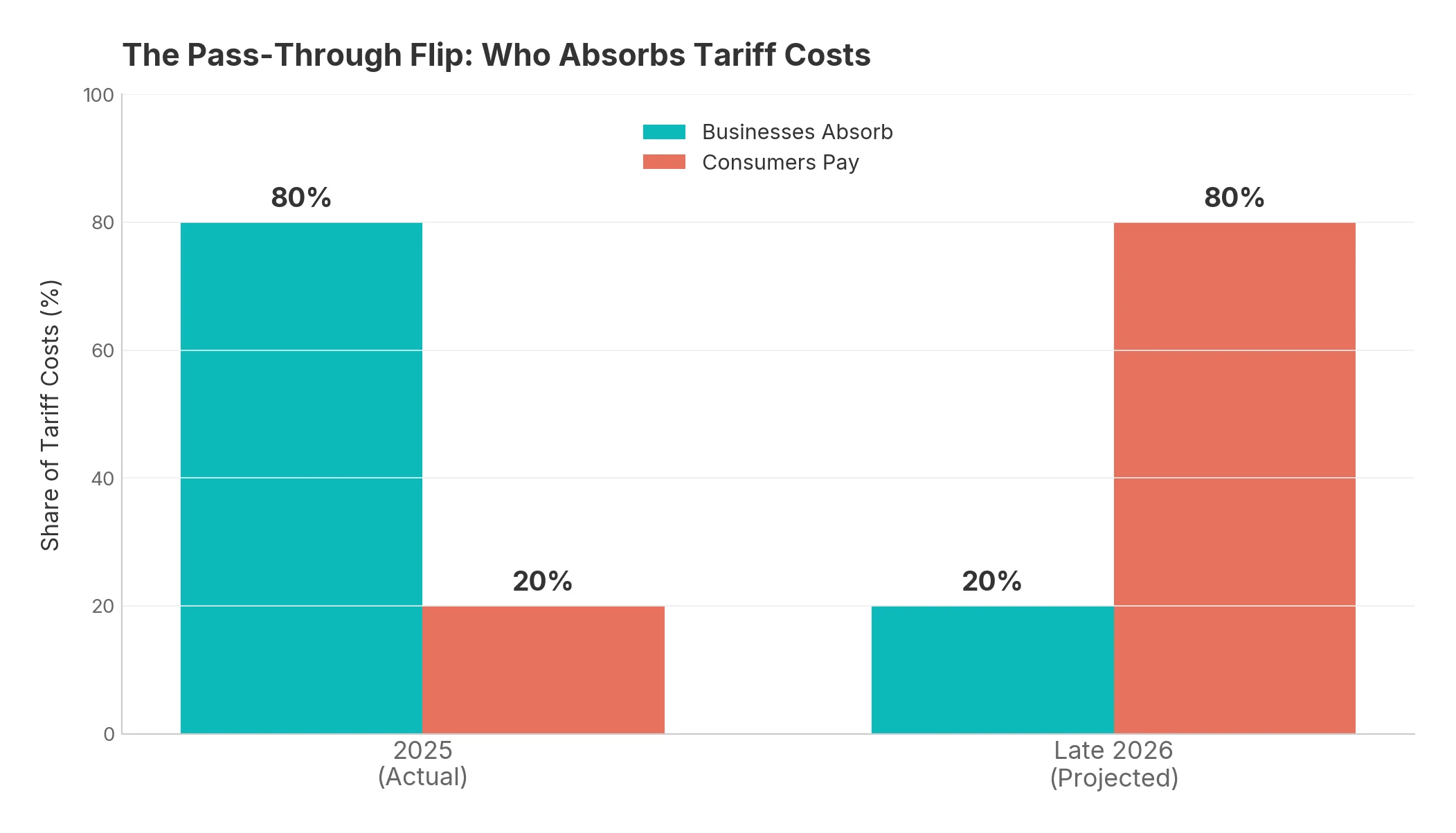
Why? Because tariff pass-through takes 12 to 18 months to fully reach retail shelves. The Federal Reserve confirmed this in a March 2026 report: tariff effects appear as "gradual and slow adjustments" — not a one-time spike.
April through October 2026 is the peak pass-through window. The prices you're seeing right now are just the beginning.
And in an April 2026 follow-up, Fed researchers found that tariff pass-through is stabilizing at roughly 100% — meaning every dollar of tariff eventually shows up in consumer prices, dollar for dollar.
Which Foods Are Getting Hit Hardest
Not all groceries are rising equally. The USDA's 2026 Food Price Outlook breaks it down:
| Category | 2026 Forecast | What's Driving It |
|---|---|---|
| Beef and veal | +10.1% | Shrinking cattle herd + strong demand |
| Sugar and sweets | +9.8% | Import costs + supply issues |
| Coffee and beverages | +6.5% | 50% tariff on Brazil |
| Fresh vegetables | +4.8% | 25% tariff on Mexico |
| All food at home | +3.1% | Broad tariff pressure |
| Poultry | +0.3% | Mostly domestic supply |
| Eggs | -26.8% | Bird flu recovery (rare bright spot) |
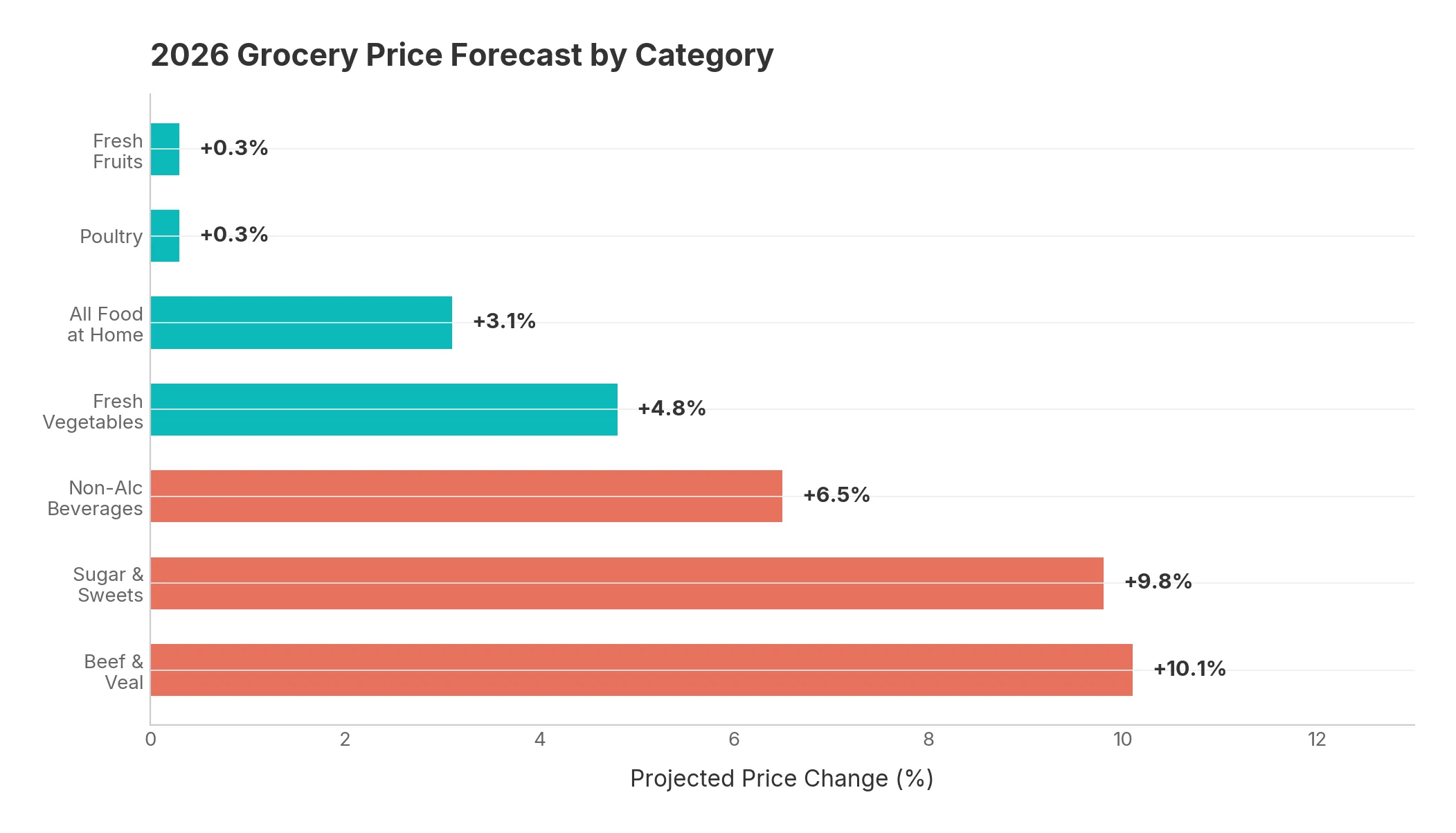
The pattern is clear: imported goods and goods that compete with imports are rising fastest. Domestic staples like poultry and eggs are holding steady or falling.
The Coffee Example: What 50% Tariffs Look Like in Your Cup
Coffee tells the whole tariff story in one product.
The U.S. imports more coffee from Brazil than anywhere else. In August 2025, a 50% tariff hit Brazilian imports. Here's what happened:
- Import costs for roasters doubled overnight: $2.20/lb → $4.30/lb
- Retail coffee prices jumped 33% year-over-year
- Brazilian coffee imports to the U.S. dropped 53% — roasters couldn't afford the same volume
- The average American drinks 3 cups a day. At higher prices, that adds up fast.
Your morning coffee didn't change. The bean didn't change. The roaster didn't change. Just a line in a trade policy — and your price jumped a third.
Who Pays the Most
Tariffs are what economists call a regressive tax — they take a bigger bite from people who earn less.
The Tax Policy Center calculated it:
- Bottom 20% of households (income under $29,000): tariffs cost 6.2% of income
- Top 1% (income over $915,000): tariffs cost 1.7% of income
That means the lowest earners pay 3.6 times more of their income toward tariffs than the wealthiest Americans.
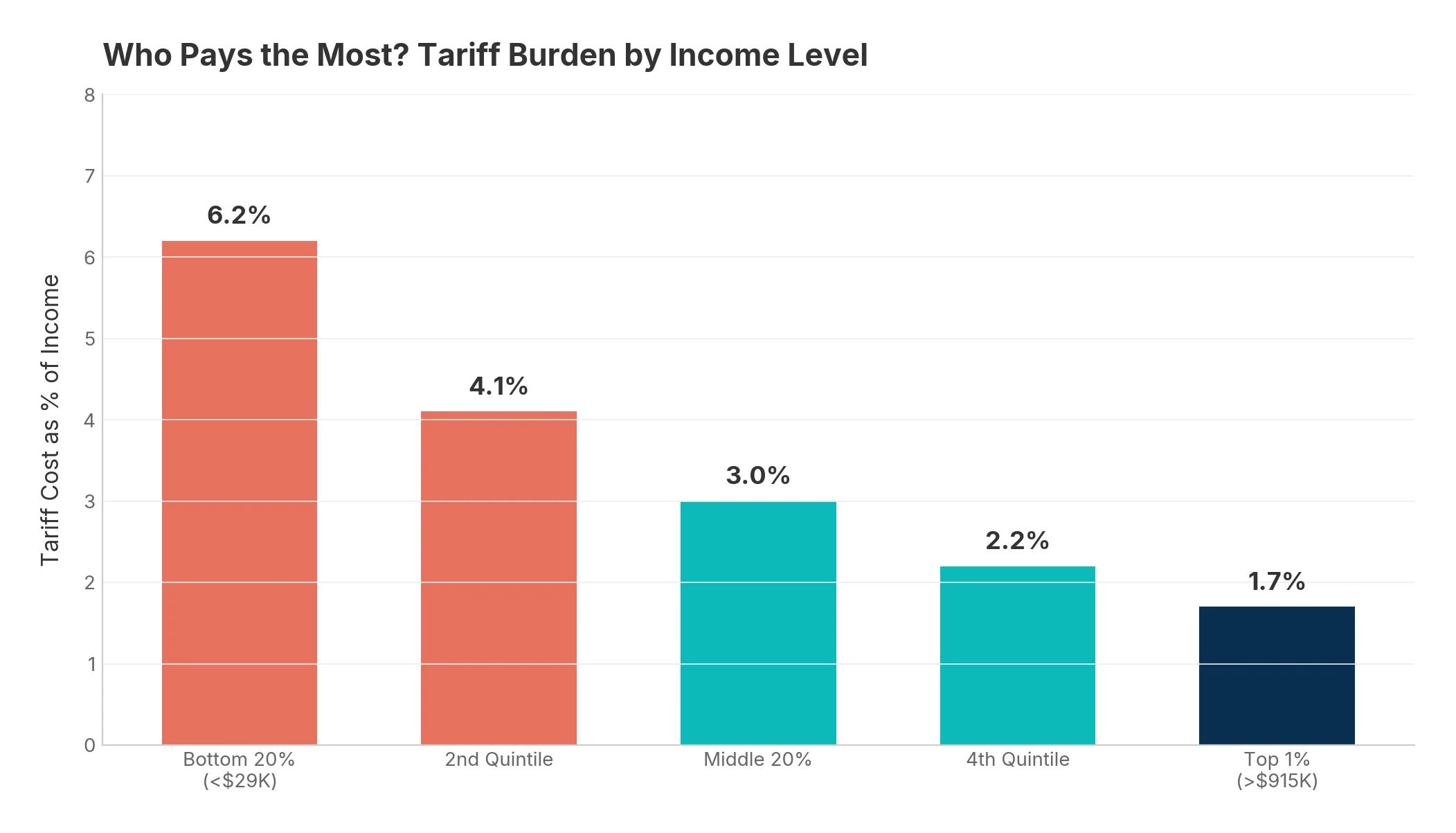
Why? Because lower-income households spend a larger share of their income on food and goods. When groceries get more expensive, there's no buffer. There's no "oh, I'll just absorb it." That $45/month has to come from somewhere — and for many families, it comes from savings that didn't exist in the first place.
The Yale Budget Lab puts it bluntly: the tariff burden on the bottom income decile is about three times that of the top decile as a share of income.
Will Prices Come Back Down?
Short answer: probably not.
Economists told NPR that even if tariffs are reduced or removed, grocery prices are unlikely to return to prior levels. The pattern is consistent across decades of data:
- Prices rise quickly when costs increase
- Prices fall slowly — if at all — when costs decrease
Researchers call this price stickiness. Once a price goes up on the shelf, it usually stays there. Companies have discovered that consumers will pay the higher price. There's no business incentive to cut it back.
This means the $540/year isn't temporary. It's likely a permanent shift in what groceries cost.
6 Things You Can Actually Do About It
You can't control trade policy. But you can control how you shop. These six moves can offset a significant portion of that $540 hit:
1. Buy Seasonal Produce
In-season fruits and vegetables are abundant, which keeps prices low. They're also less likely to be imported. When strawberries are in season locally, they're cheaper than the ones flown in from Mexico with a 25% tariff attached.
2. Stock Up on Domestic Staples
Rice, beans, lentils, canned goods, and domestically produced pasta are largely shielded from import tariffs. Build meals around these.
3. Go Frozen
Frozen vegetables, canned fish, and frozen fruit keep longer and often cost less than fresh imports. When you find a sale on frozen protein, buy a month's worth.
4. Meal Plan (Seriously — It Saves 20-30%)
This is the single biggest lever. USDA data shows that using a meal plan and shopping list cuts grocery spending by 20 to 30%. For a family spending $800/month, that's $160 to $240 saved — more than enough to cancel out the tariff hit.
5. Compare Unit Prices
Store brands often use the same domestic suppliers as name brands, at a lower price. Look at the per-ounce or per-unit cost, not the sticker price.
6. Skip Imported Specialty Items (For Now)
April through October 2026 is peak pass-through. Italian olive oil, imported chocolate, specialty cheeses — these are the items getting hit hardest. Swap in domestic alternatives for the next few months.
Where to find the $540 in your existing budget. Six shopping moves can shave the tariff bill, but the more durable fix is finding the money somewhere you're already losing it. A 30-minute subscription audit almost always uncovers $100+/month in forgotten recurring charges — enough to neutralize the grocery hit by itself. And if your tax refund is coming, our tax refund plan shows how to turn the average $3,623 check into $5,200+ of real financial value instead of watching it disappear into higher grocery receipts.
The bottom line: Tariffs are adding real money to your grocery bill, and the full impact hasn't landed yet. The best defense is knowing which prices are rising, why, and how to shop around them.
Frequently Asked Questions
How much are tariffs adding to my grocery bill in 2026? For a family spending about $800 per month on groceries, tariff pass-through adds roughly $45 per month — that's $540 per year in extra costs, on top of normal inflation. The total tariff burden across all goods is $780 to $1,338 per household, according to the Yale Budget Lab.
Which grocery items are most affected by tariffs? Beef and veal (+10.1%), sugar and sweets (+9.8%), coffee and other nonalcoholic beverages (+6.5%), and fresh vegetables (+4.8%) are the hardest-hit categories in 2026, according to the USDA. Coffee has been especially impacted by the 50% tariff on Brazil, which doubled import costs.
Will grocery prices come back down if tariffs are removed? Probably not. Historical data shows grocery prices rise quickly when costs increase, but fall very slowly — if at all — when costs decrease. Economists call this "price stickiness." Once a price goes up on the shelf, it usually stays there even if the tariff is dropped.
Do tariffs affect low-income families more than wealthy ones? Yes. Tariffs are what economists call a regressive tax. The bottom 20% of households pay 6.2% of their income toward tariff costs, while the top 1% pays just 1.7%. Low-income families spend a larger share of their income on food and goods, so tariffs take a bigger bite.
What can I do to lower my grocery bill during tariffs? Six moves that help: buy seasonal produce (cheaper and not imported), stock up on domestic staples like rice and beans, switch to frozen vegetables, meal plan with a shopping list (saves 20-30%), compare unit prices and try store brands, and avoid imported specialty items during peak pass-through months (April through October 2026).
Related Articles

Only 28% of Workers Say It's a Good Time to Find a Job — What That Means for Your Money
Gallup says only 28% of workers think it's a good time to find a quality job, down from 70% in 2022. Here's what a frozen job market costs you.

Gas Prices Just Jumped 30% — Here's What That Actually Costs You Per Week (and What to Do About It)
Gas prices rose $1.03/gallon in one month. See the real weekly cost by household type and 4 strategies to save up to $1,334/year.