The Subscription Audit: How to Find and Kill Every Recurring Charge Draining Your Budget
You're spending $133 more per month on subscriptions than you think. That's not a guess — it's what C+R Research found when they asked Americans to estimate their subscription costs, then checked the real numbers. This guide gives you the exact 30-minute process to find every hidden recurring charge and decide what stays, what goes, and what you can negotiate down.
TL;DR
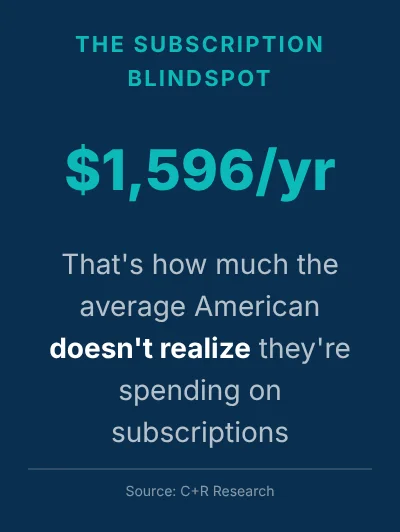
- The average American spends $219/month on subscriptions but thinks it's $86 — a $133/month blindspot ($1,596/year)
- 42% of people have forgotten about subscriptions they're still paying for
- A 30-minute audit of your last 90 days of statements will find every hidden charge
- For subscriptions you want to keep, call the retention department — they'll often cut your bill 20-50%
- That $133/month invested instead could grow to $23,000 in 10 years
Table of Contents
- The $133 Gap
- Why 2026 Is the Year to Audit
- The 30-Minute Subscription Audit
- What to Do With the Money You Save
- Frequently Asked Questions
The $133 Gap
Most people spend more on subscriptions than they realize.
C+R Research asked Americans to estimate their monthly subscription spending. The average guess was $86. Then they checked the actual numbers. The real average was $219 per month — $2,628 per year.
That's not a rounding error. People underestimate by 2.5x.
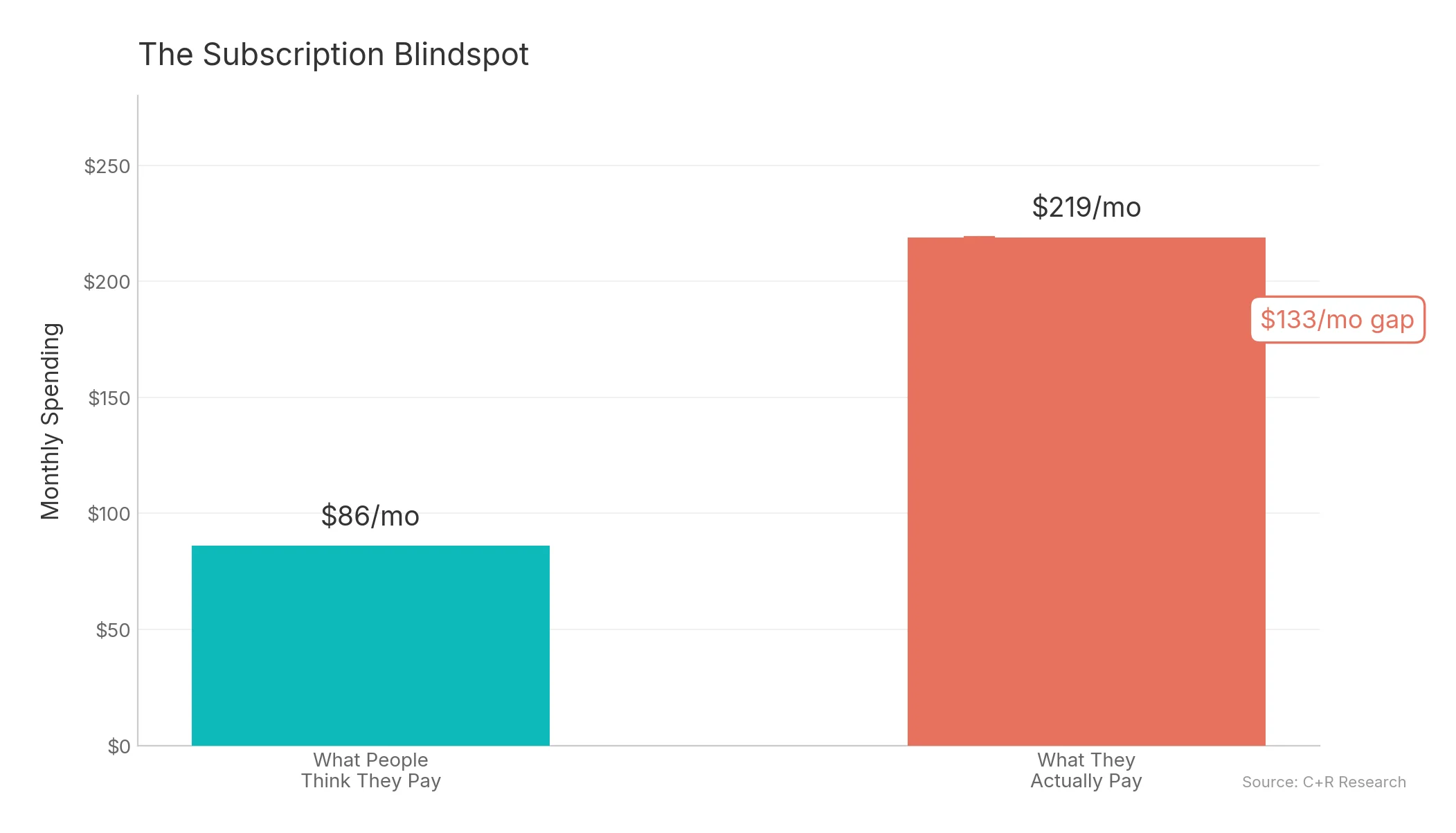
The chart above tells the story. The green bar is what you think you spend. The red bar is what's actually leaving your account. That $133 gap is the difference between intention and reality.
West Monroe's survey found that 89% of consumers underestimate their subscription spending. The reason is simple arithmetic: individual charges are small, but the average American has 12 active subscriptions. A $4.99 here and a $14.99 there add up to $219/month before you notice.
The goal of an audit isn't to cancel everything — it's to make sure every subscription you're paying for is one you'd still sign up for today.
Why 2026 Is the Year to Audit
The subscription squeeze is tighter now than it's ever been. Three things happened at once:
Streaming prices jumped. Paramount+ raised prices in January 2026. Disney+, HBO Max, and Hulu bundles all hiked in late 2025. Spotify went up. Even if you kept the exact same services, you're paying more than last year.
Utility bills climbed. The Center for American Progress reports that 242+ electric and natural gas utilities are raising rates between 2025 and 2027. The EIA forecasts electricity prices will outpace inflation through 2026. In cities like Philadelphia, the typical household is already paying $30+ more per month in combined utility costs.
Groceries squeezed too. The tariff grocery costs landing on American households in 2026 add an average $540/year to the food bill alone. Every dollar you claw back from forgotten subscriptions is a dollar that was going to get eaten by something else anyway.
The FTC Click-to-Cancel rule was vacated. The FTC finalized a rule in October 2024 that would have standardized cancellation processes. The Eighth Circuit vacated the rule in July 2025, and the FTC restarted rulemaking in early 2026. For now, the rule isn't in effect.
Between rising bills and unchanged cancellation processes, an audit this year can free up real money.
The 30-Minute Subscription Audit
This is the exact step-by-step process. Set a timer. It works.
Step 1: Download 90 Days of Statements (10 minutes)
Log in to every bank account and credit card you have. Download the last 90 days of transactions — either as a CSV or PDF.
Why 90 days? Some subscriptions charge quarterly or annually. 90 days catches most of them. If you really want to be thorough, pull 12 months.
Don't forget:
- PayPal and Venmo (subscriptions can be billed through these)
- Apple Pay / Google Pay subscriptions (check your phone settings)
- Your partner's cards if you share expenses
Step 2: Highlight Every Recurring Charge (10 minutes)
Scan every statement. Flag anything that appears more than once at the same amount. Sort them into three buckets:
| Bucket | What Goes Here | Examples |
|---|---|---|
| Essential | Would cause real problems if canceled | Rent, insurance, phone, internet |
| Nice-to-Have | You use it, but could live without it | Netflix, Spotify, gym |
| Forgot-About-It | Had no idea you were still paying | Old free trials, duplicate services, that app from 2023 |
Be honest. If you haven't used a streaming service in the last 30 days, it's not essential.
Step 3: Apply the "Fresh Start" Test (5 minutes)
For everything in the Nice-to-Have bucket, ask one question:
"If I didn't already have this, would I sign up for it today at this price?"
If the answer is no — or even "probably not" — it goes on the cancel list. This test cuts through the endowment effect, which is the psychological tendency to overvalue things just because you already have them.
Step 4: Decide and Take Action (5 minutes)
For each subscription you're not using or wouldn't re-sign up for at its current price, cancel it. For services you want to keep, check if there's a lower-tier or annual plan that would save money.
Common spots for charges people don't remember signing up for:
- Free trial conversions (48% of people forget to cancel before being charged)
- App subscriptions through Apple/Google (check Settings → Subscriptions on your phone)
- Annual renewals that auto-charge once a year
What to Do With the Money You Save
This is where it gets exciting. That $133/month you've been losing to subscriptions you forgot about? If you invested it instead — even in a basic index fund averaging 7% per year — here's what happens:
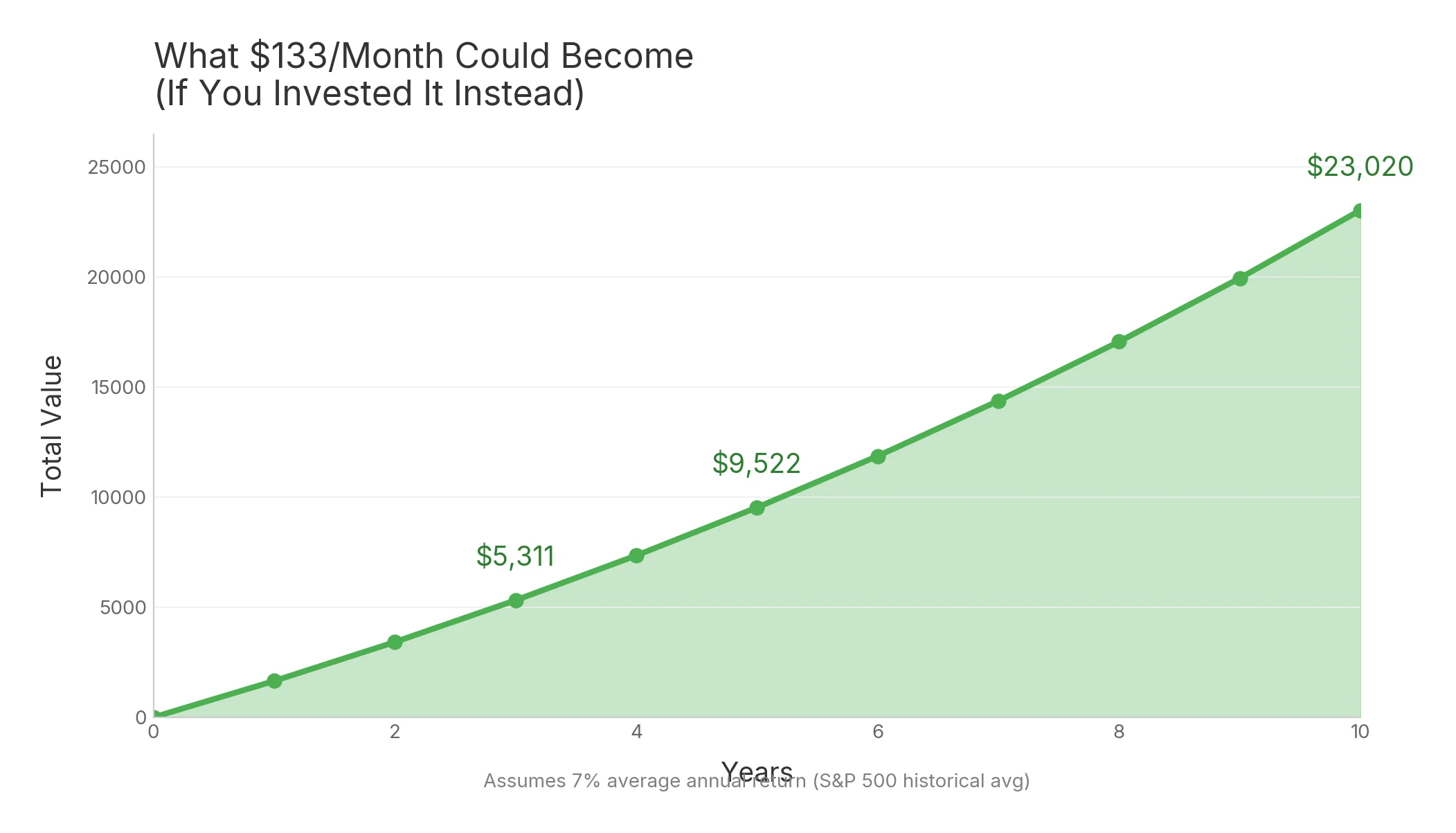
After 3 years: $5,285. After 5 years: $9,432. After 10 years: $23,005.
That's not from getting a raise or starting a side hustle. That's just from seeing the money that was already leaving your account and redirecting it somewhere it grows.
Even if you don't invest it, putting $133/month into a high-yield savings account builds a $1,596 emergency fund in one year. That covers a car repair, an ER visit, or a month of groceries — without touching a credit card.
The subscription audit isn't about being cheap. It's about taking back money you didn't even know you were spending. Pair the audit savings with our tax refund plan and you've got a combined $5,000+ that was already yours — just pointed somewhere that grows instead of somewhere that drains. Hidden subscriptions are also just one piece of the broader poverty penalty: the set of fees, surcharges, and recurring drains that cost working-class Americans roughly $3,023 a year.
Frequently Asked Questions
How much does the average American spend on subscriptions?
According to C+R Research, the average American spends $219 per month on subscriptions — that's $2,628 per year. Most people think they spend around $86 per month, underestimating by $133 every month. West Monroe found that 89% of consumers underestimate their subscription spending.
How do I find all my recurring charges?
Download 90 days of bank and credit card statements from every account. Look for any charge that appears more than once at the same amount. Don't forget to check PayPal, Venmo, Apple/Google Pay subscriptions, and annual charges that only appear once in your statements.
How much can a subscription audit actually save?
CNET's 2025 survey found the average American wastes $205 per year on completely unused subscriptions alone. When you add in downgrades and negotiated rates, most people save $100 to $300 per month. The exact amount depends on how many subscriptions you have and how long it's been since you last checked.
Is the FTC Click-to-Cancel rule in effect?
No. The FTC finalized the rule in October 2024, requiring companies to make cancellation as easy as sign-up. But the Eighth Circuit Court vacated it in July 2025, and the FTC restarted the rulemaking process in early 2026. For now, there's no federal requirement — cancellation can still be intentionally difficult.
Take 30 Minutes This Week
Set a timer for 30 minutes this weekend. Pull your statements. Sort your charges. Apply the Fresh Start test — would you sign up for each one today at today's price? For the ones that pass, keep them. For the ones that don't, redirect the money somewhere more useful.
It's one of the highest-return 30 minutes you'll spend this month.