
Money Fights Last Twice as Long as Any Other Argument. Here's the Script to End Them.

You'd think money would be the thing couples fight about most. It's not. Kids, chores, and communication all rank higher.
But here's what the research actually says: when couples do fight about money, those fights last nearly twice as long, come back more often, and leave more emotional damage than any other kind of argument. And 57% of Americans say financial stress has already damaged their relationship.
This isn't another "just communicate better" article. I pulled the actual language real couples use when money fights happen — and built a specific, word-for-word script to start the conversation that matters.
TL;DR
- Money fights are less frequent than arguments about kids or chores — but they're nearly twice as destructive (27-36 minutes vs. 15-21, and 60% recurrence vs. 48%)
- 57% of Americans say financial uncertainty damaged their relationship (Northwestern Mutual, 2025)
- The #1 trigger isn't debt or income gaps — it's daily spending (the $12 subscription, the $38 dinner)
- The real emotion underneath isn't anger — it's betrayal: "You made me believe one version of our life while you were living another"
- Below is a two-conversation script built from real language, not therapy-speak
Table of Contents
- The Numbers Nobody Puts Together
- It's Not About the Money
- What Couples Actually Say
- The Same Team Script
- The Cash-Flow Timing Problem
- Frequently Asked Questions
The Numbers Nobody Puts Together
Everyone knows money causes relationship stress. But the specific numbers tell a different story than you'd expect.
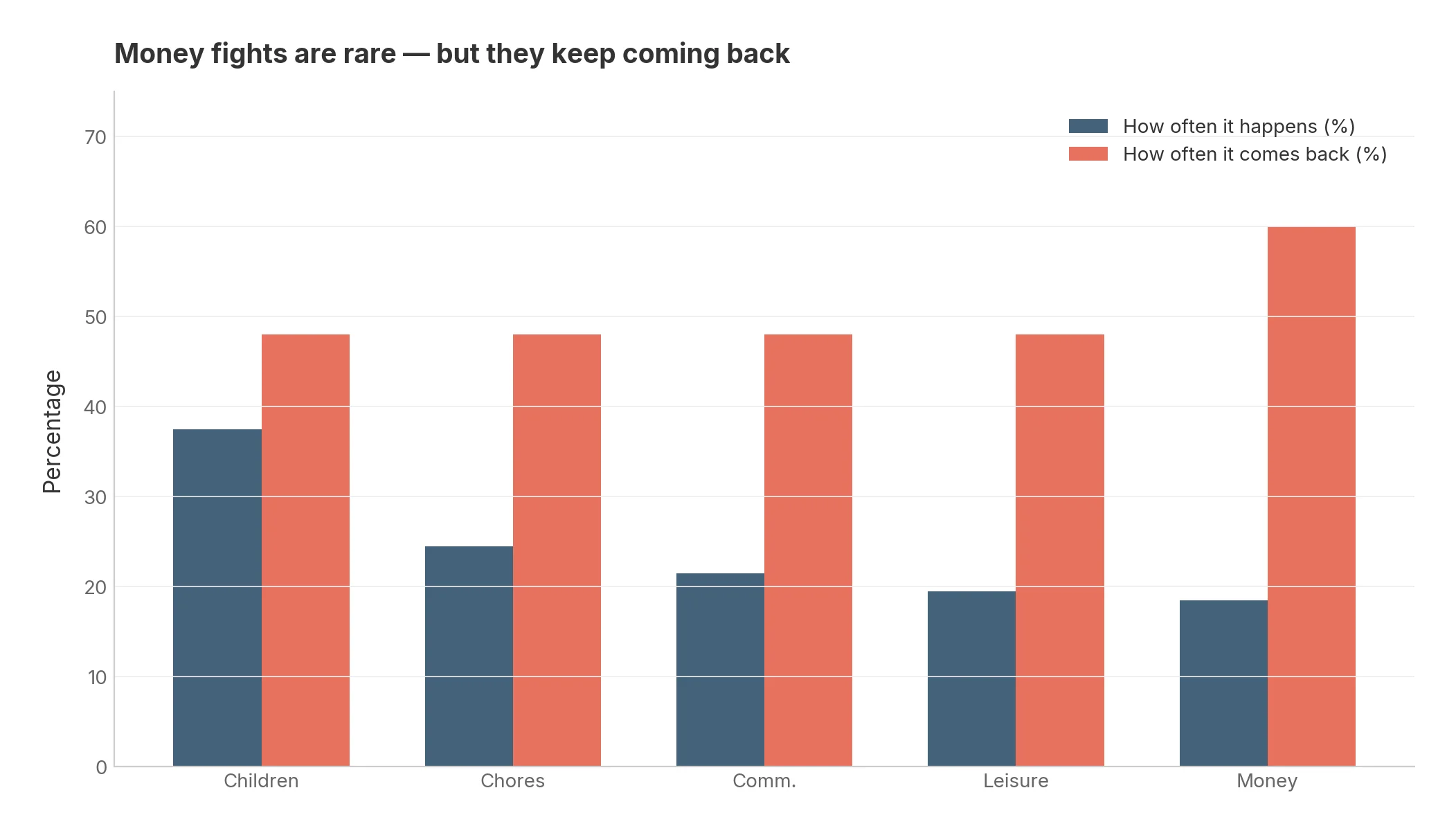
According to a peer-reviewed study in the Journal of Family Psychology (Papp, Cummings & Goeke-Morey), money arguments are actually less common than fights about children (36-39% of conflicts), chores (24-25%), or communication (21-22%). Money comes in at just 18-19%.
But here's the catch. Those same researchers found that money fights:
- Last 27-36 minutes (vs. 15-21 minutes for other topics)
- Recur 60% of the time (vs. 48% for other conflicts)
- Produce more anger and depressive behavior
- Are less likely to be resolved
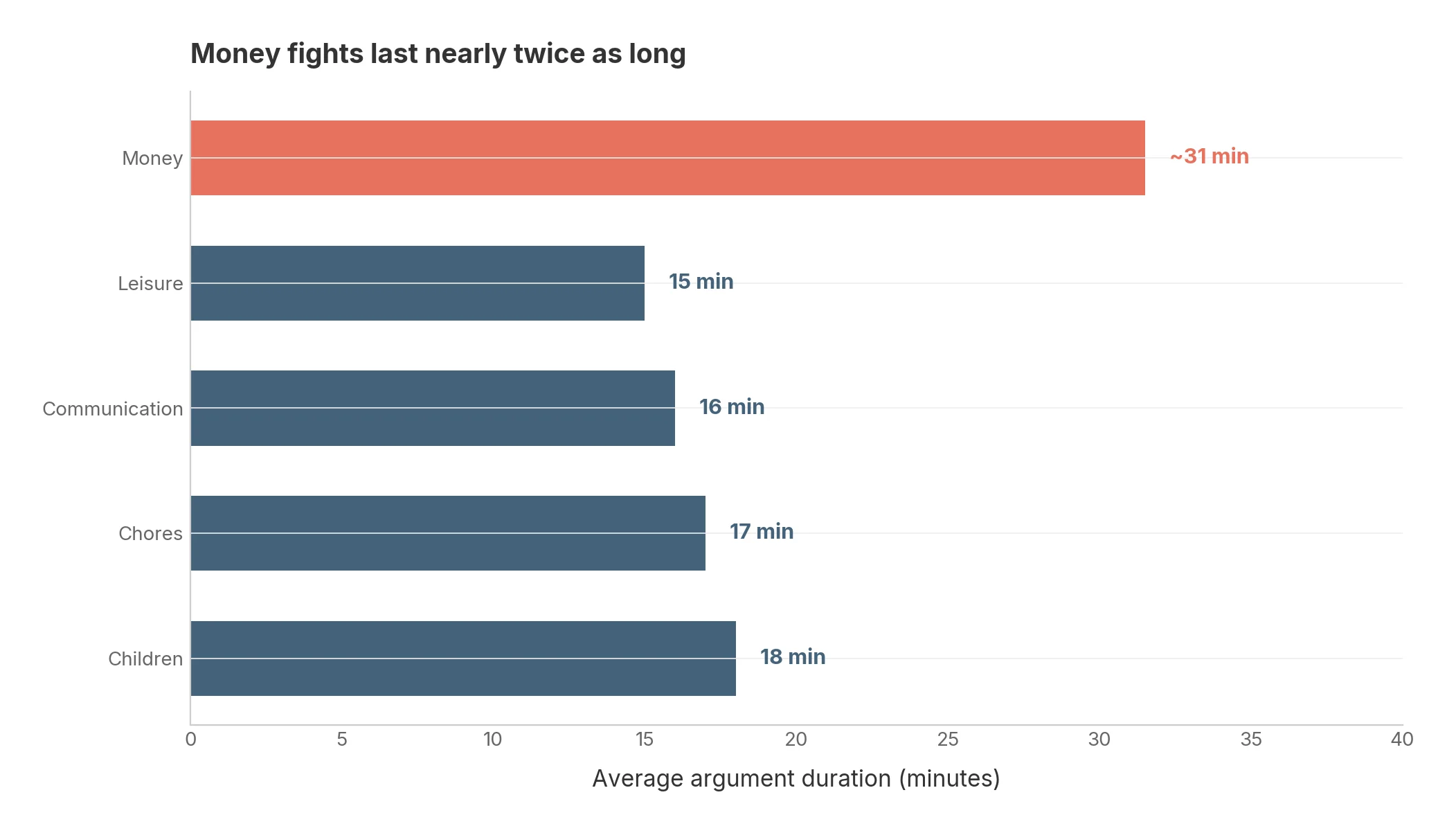
Money doesn't start the most fights. But the ones it starts hit harder and stick around longer.
Meanwhile, Northwestern Mutual's 2025 Planning & Progress Study found that financial uncertainty's impact on relationships jumped from 44% to 57% in just two years. It's getting worse, not better.
And 73% of Americans in the AICPA/Harris Poll say financial decisions are a significant source of tension in their relationship. Not "sometimes stressful." Significant tension.
It's Not About the Money
The biggest surprise from the data: the #1 trigger for money fights isn't debt. It's not income inequality. It's not a job loss.
It's daily spending. The $12 impulse buy on Amazon. The $38 on steaks when you're behind on rent. The $4 coffee that somehow represents everything wrong with how your partner handles money.
28% of money arguments start over routine, day-to-day purchases. Not the big stuff. The small stuff — because the small stuff is what makes someone feel like their partner isn't on the same page.
And here's what makes it worse: a 2026 study from Harvard Business School and Wharton (Garcia-Rada et al., published in Social Psychological and Personality Science) found that couples systematically underestimate how well money conversations go. We expect them to be terrible, so we avoid them. But when couples actually talk, it goes better than predicted — every time, across three separate studies.
We're avoiding a conversation that would actually help. Because we're scared of a fight that's mostly in our heads.
What Couples Actually Say
I pulled stories from relationship forums to find the actual language people use when money fights happen. Not the sanitized survey version. The real words.
The patterns are clear:
The betrayal discovery. This is the #1 emotional dynamic. Not anger — betrayal.
"I found out he had $45,000 in credit card debt. He'd been hiding it for three years. While I was packing lunches to save $50 a week."
"She had a separate savings account I didn't know about. $12,000. She called it her 'escape fund.'"
The common thread: You made me believe one version of our life while you were living another.
The control dynamic. When one partner earns more and uses it as leverage:
"He put me on an 'allowance.' I'm 34 years old."
"Every time I buy something, I have to justify it. Even a $15 shirt from Target."
The resentment spiral. Small purchases become proxies for larger value clashes:
"She bought $38 worth of steaks while we were behind on rent. It wasn't about the steaks. It was about what the steaks meant."
"I'm working two jobs while he buys video games. When I bring it up, I'm 'nagging.'"
The dollar thresholds. Fights cluster at two ranges: $15-50 for daily spending triggers, and $10,000-30,000 for hidden debt discoveries. The small range is where arguments start. The large range is where relationships end.
The Same Team Script
Based on what real couples say — what actually triggers fights, what makes them worse, and what language defuses them — here's a two-conversation approach.
Conversation 1: Feelings First, Numbers Never
Timing: Not during a fight. Not after a purchase. Pick a calm moment. Say this:
"I want to talk about something that's been on my mind. Not because anything is wrong — because I want us to be on the same team with money."
That framing matters. "Same team" signals collaboration. It's not "we need to talk" (which triggers defensiveness) or "you spent too much" (which triggers shame).
Then: share your own feeling first. Not their behavior. Yours.
"I've been feeling anxious about money lately. Not about anything specific you did — just a general tightness. I wanted to tell you instead of carrying it alone."
This creates mutual vulnerability. The research (Garbinsky et al., Journal of Consumer Psychology) shows that reframing financial problems as "solvable" rather than "perpetual" significantly increases willingness to communicate.
Do not mention numbers in this conversation. No dollar amounts. No budgets. No "you spent $X on Y." This conversation is only about feelings.
Conversation 2: Numbers Together, 48 Hours Later
Wait at least 48 hours. Then:
"Remember what we talked about? I think it would help if we looked at our actual numbers together. Not to judge anything — just to see where we are."
Sit side by side (not across from each other — positioning matters). Open your bank app or a shared spreadsheet. Look at the numbers together as a team reviewing data, not a prosecutor presenting evidence.
The key rule: React to the numbers, not to each other. "Wow, we spent $600 on food delivery" is fine. "You spent $600 on food delivery" is a fight.
The Cash-Flow Timing Problem
Here's what none of the relationship articles mention: many money fights aren't about how much you earn or spend. They're about when.
The 3-5 days before payday. The unexpected $200 car repair on the wrong Tuesday. The gap between when a bill is due and the money hasn't arrived yet.
That timing gap creates stress. Stress creates fights. Fights create damage.
This is the specific, mechanical problem that cash flow tools like Panda Pay exist to solve — not by fixing your relationship, but by removing the timing pressure that turns a Tuesday into an argument.
Frequently Asked Questions
What's the #1 thing couples fight about with money? Daily spending — routine purchases like subscriptions, groceries, and small indulgences. Not debt, not big purchases. 28% of money arguments start with everyday spending (Money Mentors/Angus Reid, 2026).
How long do money fights last compared to other arguments? Money fights last 27-36 minutes on average, compared to 15-21 minutes for arguments about children, chores, or communication. They also recur 60% of the time vs. 48% for other topics (Papp et al., Journal of Family Psychology).
Is it normal for money to cause relationship problems? Yes. 57% of Americans say financial uncertainty has damaged their relationship (Northwestern Mutual, 2025), and 73% cite financial decisions as a source of significant tension (AICPA/Harris Poll). You're not alone.
How do you start a money conversation without starting a fight? Lead with feelings, not numbers. Say "I want us to be on the same team with money" — not "we need to talk about your spending." Share your own anxiety first. Save the actual numbers for a separate conversation 48 hours later.
Does talking about money actually help relationships? Yes. A 2026 study (Garcia-Rada et al., Social Psychological and Personality Science) found that couples consistently underestimate how well money conversations go. The conversation you're avoiding would actually go better than you think.
Money fights aren't about money. They're about trust, control, and feeling like you're on the same team. The script above isn't magic — but it's specific, and specific beats "just communicate better" every time. And if part of the stress is figuring out what to do when your paycheck doesn't stretch far enough, solving that mechanical problem can take real pressure off.
If the timing gap between bills and paychecks is adding pressure to your relationship, Panda Pay's Cash Flex can bridge that gap — up to $100, no interest, no credit check.
